
The check in for the Air Koryo flight was chaotic. Most of the passengers had a large quantity of boxes and other luggage. It reminded me of our check in for a PIA flight to Lahore, only less organised. Passengers kept going behind the check-in desks, retrieving their luggage, and putting it through the procedure again. I couldn’t work out what was going on, and was a bit concerned about the security implications. However, when it was finally our turn to check in, I was told to do the same. I have no idea what the problem was, and my husband Neil didn’t have to undertake the same procedure.
The flight itself was fine. The aircraft was modern and had video screens showing a classical concert. This was footage that was to become very familiar to us over the next week. On arrival, immigration was surprisingly straightforward. We just handed over the immigration form, health form and customs form we had completed on the flight to the relevant individuals. I had expected customs to be difficult, but although I had to show them my cameras and the book I had in my hand luggage (Pickwick Papers, deliberately chosen as seasonal and hopefully uncontroversial). They weren’t interested in checking my suitcase at all.
We were met by our two guides (one male, one female) and driver, and were soon on the way to Pyongyang. The roads were very quiet. We stopped for photos at the Arch of Triumph, before arriving at the Yanggakdo hotel on an island in the middle of the river. Our room was on the 40th floor. It was better-appointed than I had expected, with a bath and shower, toiletries, decent towels and a kettle. The TV could even get English language news from Al Jazeera with good reception, or BBC World with a rather snowstormy picture.

That evening we were taken out to dinner in a Korean restaurant. It was a barbecue – with duck, beef and squid cooked over a burner on the table, served with kimchi. The lights went out several times, but the staff quickly brought lamps, in what was clearly a standard operating procedure. There was live music from an all-girl group who sang and danced. The drummer was particularly enthusiastic. For the second course we were offered a choice of rice or Pyongyang noodles. We chose the noodles – a local speciality. They were served cold in a brass bowl of soup, with meat and hard-boiled egg on top. Perfectly edible, if difficult for novices to handle, and to my mind slightly reminiscent of Klingon gagh.
Our first visit of the following day was to the Kumsusan Palace of the Sun, where Kim Il Sung and Kim Jong Il were laid to rest. We had been advised that smart dress as necessary, so Neil wore a tie, and I wore a formal jacket and trousers. On arrival we were asked to wait in a side room until more people arrived. Reading matter in the form of dual language magazines celebrating North Korean achievements was provided. Eventually, more visitors, some of whom seemed to have taken little trouble with the dress code, arrived and we were taken to a cloakroom area where we had to leave our coats and cameras. Then we had to walk over shoe-cleaning brushes and pass through a security check before stepping on to travellators, which took us at a stately pace past photographs of Kim Il Sung and Kim Jong Il in various locations whilst music played. One of our guides told us that the music was called Our Leaders Are Always with Us. This was very apt. Everywhere we went were statues and pictures. Often they were depicted visiting industrial sites or collective farms to provide advice on how they should be run.
We arrived in a hall with larger-than-life coloured statues of Kim Il Sung and Kim Jong Il and then went into the mausoleum of Kim Il Sung. We had to approach in groups of four and bow to the front and at each side of the glass coffin. One of our guides asked me if we had anything similar in the UK, and I found myself trying to explain the concept of Jeremy Bentham, whose dressed skeleton or auto-icon is on display at UCL. I also explained that our Heads of State were buried in Westminster Abbey, but that as the Queen had been on the throne for over 60 years, the situation hadn’t arisen for a long time. We then went into a room displaying all the medals and honours Kim Il Sung had received, which it seemed were mostly from Eastern Europe, Palestine, Pakistan and Peru, plus honorary doctorates from several universities and honorary chieftain’s robes from Niger. The whole process was then repeated for the mausoleum of Kim Jong Il. After that, we entered a room containing Kim Il Sung’s very ornate private train, with a light-up map of all the countries he visited (by trail and by plane). We proceeded through a further series of rooms containing Kim Il Sung’s car, Kim Jong Il’s car, then a boat, and finally Kim Jong Il’s private train.
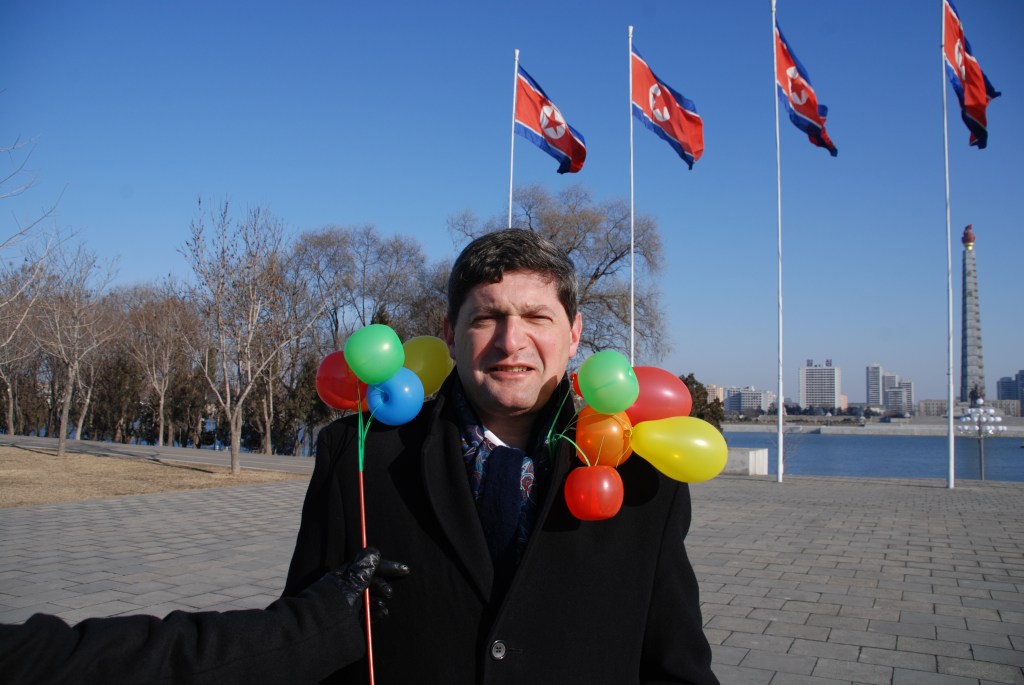
After retrieving our coats and cameras, we went into the park outside, where we were allowed to take photographs. It was very cold (-11C) and the river was frozen solid. A number of locals were also visiting, some in national dress.
Our next stop was the Revolutionary Martyrs Cemetery on Mt Taesong, where the graves of c.200 leading resistance fighters from the Japanese occupation, including Kim Il Sung’s wife, Kim Jong Suk, were located. Each grave had a bust of the deceased. Kim Jong Suk had pride of place, and locals had left many floral tributes. We were also able to have a look at the view over Pyongyang, before returning to our minibus, and driving back to the hotel for a lunch of chicken, noodles, soup, rice and egg.
After lunch we were taken to the Pyongyang Grand Theatre, and walked from there to Kim Il Sung Square, where we noticed numbers painted on the paving. These are so that people know where to stand for the official celebrations. We stopped at the Foreign Language bookshop, where I bought a guidebook to North Korea, some postcards and a small book of Kim Il Sung’s memoirs (€13.10 in total). As it was a holiday in North Korea, the pavement kiosks were selling balloons – our guides bought us each a bunch of small balloons on a stick – our first ‘what do we do with this present?’ challenge.
We had been offered the opportunity of going to the Pyongyang Circus for €20 per person and decided to go. The Circus is a large and impressive permanent building. The show was mainly based on acrobats and trapeze artists (3 separate trapeze performances, plus balancing acts, including one who climbed higher and higher on a series of interlinked sticks and then did the splits, and another who balanced on a board on a rolling cylinder or series of cylinders). There were also jugglers, comic interludes with a plate spinner and stooge from the audience and a pair of acrobats with three stooges from the audience, and two performing bears. Being British, I was sorry for the bears, but our guide thought them very funny.
After the performance ended, we went to the Mansudae fountain park at the foot of Mansu hill, though the fountains were not working owing to the cold weather. Then it was time for us to pay our respects to the 20 metre tall statues of Kim Il Sung and Kim Jong Il at the Mansudae Grand Monument. We were offered a choice of two floral tributes at €5 each, but Neil handed over €10 so that we had one each (there was not much to choose between them). We duly presented the flowers and bowed in accordance with our guides’ instructions.
Dinner was another cook-it-yourself affair, this time Korean hotpot, where you get a pot containing cold soup sitting over a burner, to which you add in turn raw pork, vegetables, tofu and egg. Over dinner we attempted to explain English food to our Korean guides: Lancashire hotpot, Cornish pasties, pastry and pies.
I had had problems making the shower work, so our guides came up to our room to demonstrate the technique. Neil took the opportunity to ask them why there was no 5th floor button in the lift. They explained that the fifth floor was for ‘administration and staff only’ (according to some internet posts, it’s a secret surveillance bunker).
The next day our sightseeing began with a ride on the Pyongyang Metro. We visited three stations, all of which were very beautiful, with chandeliers and mosaics on the platforms. Mostly they were in Soviet-realist style, but one had views of Pyongyang on either side, as if the platform was the Taedong river.

After that we went to the Fatherland Liberation War Museum, where we were met by a female army officer guide. Before entering the museum itself, we were shown the displays of weaponry on either side of the entrance. To the right, blackened and twisted wrecks of captured US (and other allied) guns, planes, amphibious vehicles etc. including a helicopter shot down in the 1960s. To the left, North Korean weaponry and military vehicles and planes, in good condition, with medals painted on. We were also shown the USS Pueblo, an 850 ton US spy boat that was captured by the North Koreans off Wonsan in 1968, and is now moored on the Pothong river, adjacent to the museum. On board, we were shown the crew’s quarters, the cryptography room and the signed ‘confessions’ of the crew.

Just as we were about to go inside the museum proper (a new building was constructed in 2013 for the 60th anniversary), we found out that there had been a power failure, and after waiting outside with the guide for a little while, it was decided to abandon the visit and come back on Thursday.
In the meantime, our minibus had gone for petrol and a change of tyre, so we stood around in the car park outside the old museum building (now used as offices for the military) for half an hour, watching a soldier trying to clean a stone chip out of the bonnet of his car. When the minibus finally returned we set off for Mangyondae, the (alleged) birthplace of President Kim Il Sung, which he left as a teenager, returning 20 years later at the liberation. It is a carefully preserved rural house. While we were walking around the site, our female guide (who complained about the cold a lot) mentioned that before our tour she had been volunteering on a construction site, which had not been as cold as it was in the Pyongyang area. Apparently many guides volunteer for three months on a construction site.
After lunch in the KITC restaurant (chicken, pork with cabbage, dumplings, sausage, omelette, kimchi and a sort of chip fritter), we were due to visit a supermarket where allegedly we would be able to change money to North Korean currency and buy things, but it was closed (in lieu of the previous day’s holiday), so we were taken instead to a department store, and left to our own devices to look round, whilst whilst our male guide reconfirmed our flights home at the Air Koryo office next door, and our female guide also disappeared (perhaps to do some shopping of her own?) The food hall downstairs had some imported confectionery and snacks: Smarties, Werther’s Original, Haribo, Kitkat, After Eight, Pringles (Pringles cost 700 won, Werther’s Original 350 won, but we had no idea how much that actually was). We did ask our guides about exchange rates but were told that ‘it’s complicated.’ Other goods on sale included basic toiletries, perfumes (the only familiar one I noticed was Anais Anais), clothes, fridges, cuckoo clocks, TVs. Our male guide found me in the sportswear section and handed over the confirmed tickets, then disappeared again. It felt like something from a spy movie.
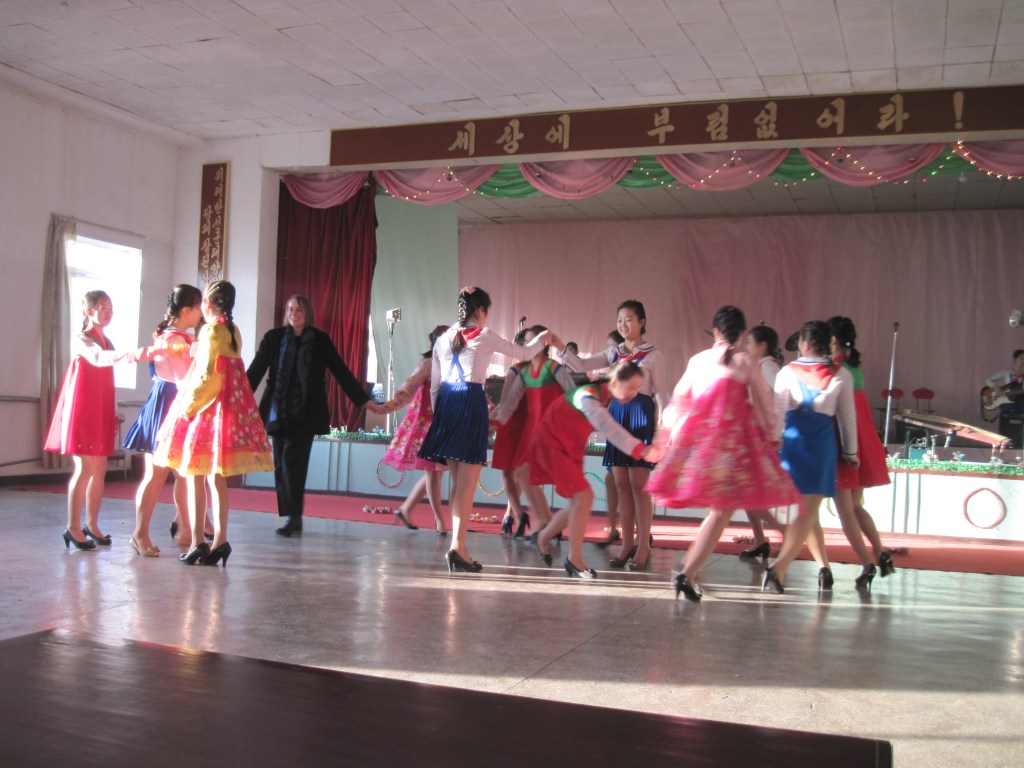
After we had explored the shop for slightly longer than was necessary, we were taken to a secondary school: 9th June School, named after its foundation date. Our local guide was a teacher from the school. We were first shown a room with information about the history of the school, before going to a classroom, where the pupils were too embarrassed to talk to us (this feeling was mutual). Then the teacher found three members of the English club who would talk to us. Two of them wanted to be scientists and one wanted to be a teacher. They were also interested in football but didn’t know much about western teams – the only ones they had heard of appeared to be Real Madrid and Manchester United. After that we saw a musical performance (just for us) by some pupils, involving singing, dancing, playing instruments (including accordions and a very enthusiastic drummer). At the end, we were invited to join them. Neil naturally wouldn’t, so I had to go it alone. It was actually good fun – a sort of cross between the conga and the Gay Gordons.
After we left the school we had a two hour drive to Mt Myohyang. The car swerved a few times – I think to avoid potholes rather than because of ice, but it was unnerving. We saw people walking beside the road, often where there was no obvious housing or settlement in sight. I also noticed two workmen with a JCB and a brazier and also groups of people shovelling a heap of earth with spades. The final part of the journey was very bumpy – it was like the Belgian pave track that they use on Top Gear as a test for old cars to see how far they can get without bits falling off the vehicle.
We were very relieved to arrive at the Hyangsan Hotel (one of the best hotels in the country, according to our itinerary), and certainly very swish – we had a suite with a sitting room, bedroom and two bathrooms. We had dinner in Restaurant no. 2 – just Neil and me (the guides were eating elsewhere): chicken and glass noodle soup, trout en papillote, a meat dumpling and potato croquette. Allegedly internet access was available if you had a laptop to connect. We hadn’t brought one, so they opened the ‘business centre’ for us. It was very smart, but the PC was running Windows XP, and the member of staff couldn’t get it to connect at first – he had to phone for help twice. Eventually we did get through to the outside world – Neil was able to access the cricket scores.

Our first visit was to the Pohyon Temple, which dates from the 14th century, although parts of it were destroyed by bombing in the Korean War and subsequently restored (apparently on the ‘advice’ of Kim Il Sung). I was surprised to find a monk there, and to be invited to pray with him. I declined, but did make a donation towards costs. At the end of the visit was a little gift shop, where I bought some beads made from scented wood.
Then we went to the International Friendship exhibition: a huge museum built into the side of a mountain which displays gifts to the North Korean leaders. All bags, keys, cameras and coats had to be left at the entrance. Once through security, we had to bow to a statue of Kim Il Sung. Then we saw three cars given to Kim Il Sung by various Soviet leaders, including one with bullet proof glass that was a gift from Stalin during the Korean War. Another thoughtful gift from the Russians was a plane – I was able to go up the steps to peep into the cabin and admire the green plush sofa. From there we saw gifts to Kim Jong Il and Kim Jong Un, including a sword from General Gaddafi, a gun from Vladimir Putin, numerous bearskins, computers, cameras, a rather nice enamel of St George (or General Georgy, as Soong described him) from the USSR (I’m fairly sure it was of Armenian origin), and basketballs (and a Burberry handbag) from Denis Rodman. We continued into a network of corridors downstairs where there were gifts to Kim Il Sung, including a cuddly toy (a large stuffed bear from a workers’ group in East Berlin), ceramics, including portrait plates from China and many rather kitsch items.

After we had collected our belongings at the entrance, we were asked whether we would like to go up to the balcony for photos. We said that we would and were led back inside and then up in a lift, where we emerged …in the gift shop. We went out onto the balcony and took some photos, and then accepted the offer of tea. I bought a couple of items, including a leaflet about the exhibition.
We had lunch back at the hotel: soup, fish, rice wrapped in a thin omelette and strips of potato. There was a small wedding group taking photos outside the hotel as we were leaving: the groom in army uniform and the bride in traditional dress. Our guides asked if we would like photos. It turned out that the bride and groom would like us to be IN the photos, so we duly obliged. After a shot of the pair of us with the bride and groom, the other guests joined us, and Soong and Buk took photos with all their cameras as well. I have no idea who any of them were.
The drive back to Pyongyang was slightly less hair-raising, as it was in daylight. We now had the opportunity to visit the supermarket, which occupied three floors and was very busy, with people preparing for the new year holiday. Food was on the ground floor, clothes on the first floor and café tables on the top floor. Our guides told us to find out what we wanted to buy, then change money, see you in half an hour and promptly disappeared. Leaving us in shops was becoming a habit. We tried to go into the food hall, but a woman stopped me from taking my handbag in. I had to put it in another bag which was provided. I did this reluctantly, but then found that they wouldn’t let me take that in either. There was no way I was leaving my handbag with half our holiday money in that chaos, so I decided to give it a miss, though Neil did go in.
We then had a long drive down to Kaesong. There were four army checkpoints on the route. In two cases Buk had to get out, but we were waved through the other two. We made a stop at a tea house, so that the driver could have a brief rest. Unfortunately it was closed – completely dark and shut up. The guides and driver knocked repeatedly and managed to get someone (with a torch) to let them in, leaving us in the car (our female guide joked that if we could drive the car we could abscond in it, but we decided to stay put).
On arrival in Kaesong, I found that my fears about the ‘Folkcustoms Hotel’ were realised. It was a traditional Korean building with paper walls, no shoes indoors, and mattresses on the floor. It was freezing in there. As a concession to the temperature, our dinner was served in a normal room, rather than the Korean restaurant with low seating. The one positive point was that there was underfloor heating (also traditional Korean – using heat from the kitchen), so that the beds on the floor were actually very cosy and warm – too warm if anything).
In the morning there was no power (though someone not far away had enough power to play patriotic songs at 5.00 a.m.) so we had to wash in cold water by torchlight. Still at least there was water, which is an improvement on the situation in our hotel in Mary three years previously – why do we end up in freezing hotels without power in December?
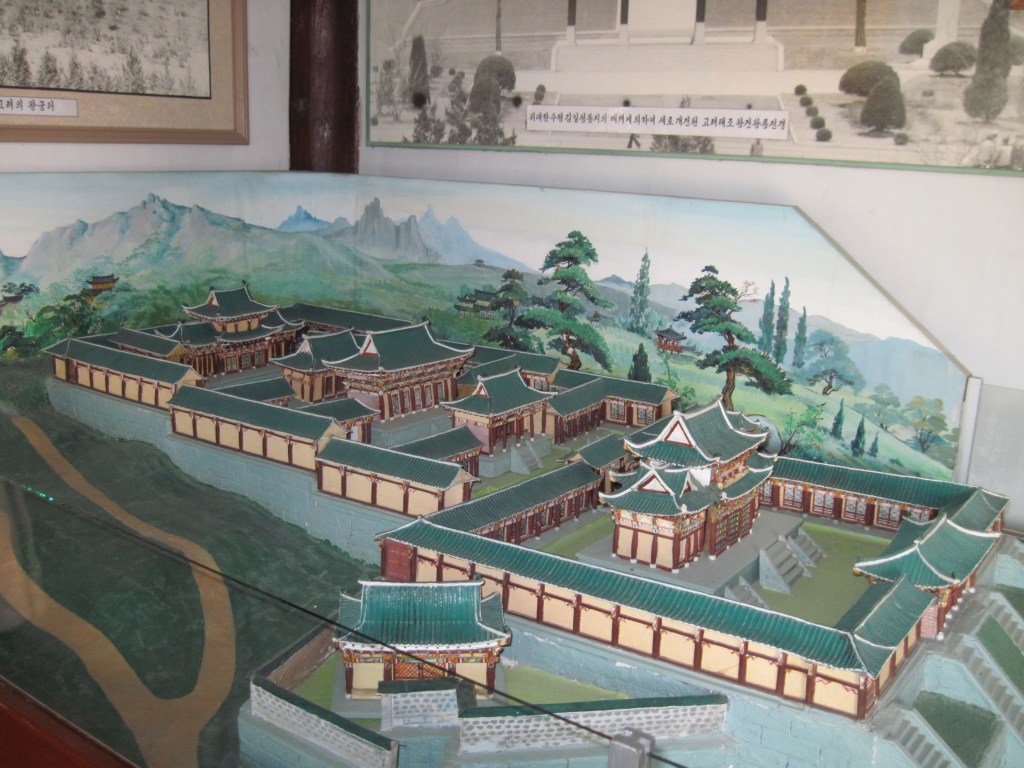
We walked through Kaesong, past the historic south gate (the base of this is original, but the pavilion was reconstructed after the war) and up Mt Janam, passing another bronze statue of Kim Il Sung on the way. We were met there by the minibus, which then took us to the Koryo Museum. This was on the site of a former university, originally founded in 992 to train government officials, later being used under the Ri dynasty for education in Confucianism. There were displays about the layout of Kaesong, historical tools, weapons, coins and ceramics (celadon ware), costumes of peasants and landowners, reconstruction of a tomb. Interesting, but clearly all done on something of a tight budget. In 1992 the adjacent Kaesong College of Light industry was promoted to university status on the 1,000th anniversary of the founding.
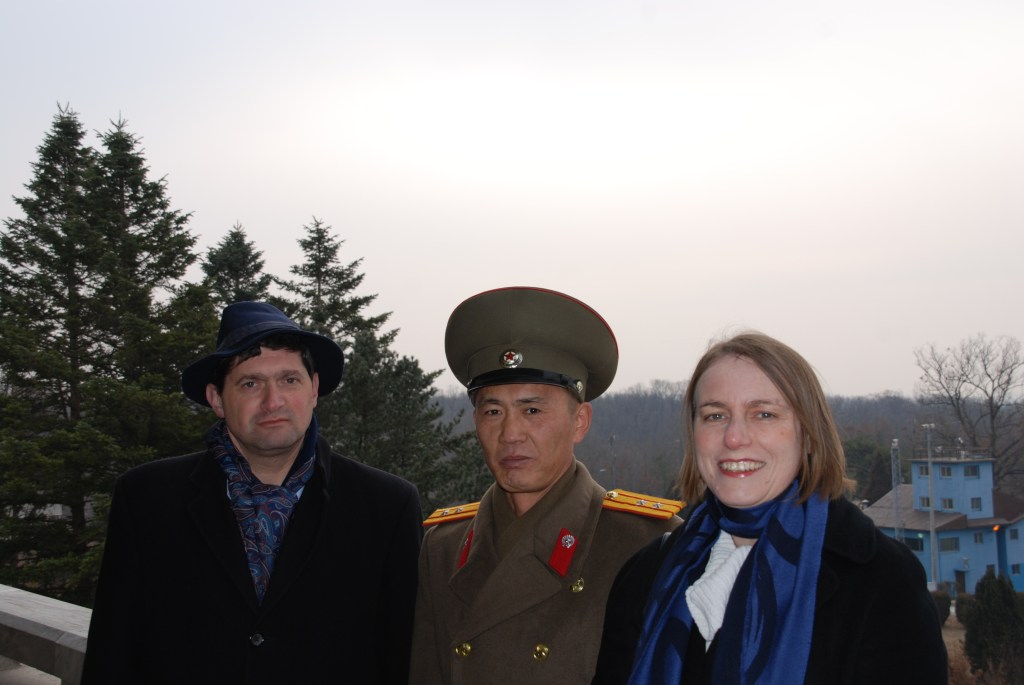
We then drove to Panmunjom to see the De-Militarized Zone. We initially had to wait in the gift shop for another group to arrive. Whilst we were waiting I bought a very pretty watercolour of Kaesong for €5. Then our military escort arrived and showed us the layout of the site on a map. We then drove (with the military escort) to the hut where the Armistice talks were held and the Hall where the Armistice agreement was actually signed. According to our military guide, the Americans wanted to sign the agreement in a tent, but Kim Il Sung insisted on a permanent building. The evil Americans didn’t even bring their own flag, but turned up with a United Nations flag (which has been preserved). We then proceeded past a memorial bearing Kim Il Sung’s signature (he visited the day before he died) to the conference hall of the Military Armistice Commission, which straddles the border, with South Korean soldiers on guard. The tables have microphones down the centre. We then went up to the balcony of Panmum House for photographs, including a some with our military escort. We had a conversation about history with him (with our guides acting as translators). He asked if we know how many British soldiers fought in the Korean War (we didn’t know, having not had time for as much preparatory reading as we would have liked), and also about the Queen. I explained that I was a medievalist. (Earlier in our trip, one of our guides had asked me which period of British history Game of Thrones was set in. I had to admit that I hadn’t actually watched it.)
We then went to the Sonjuk Bridge – a historic monument that was the scene of a famous assassination in 1392 when Jong Mong Ju, a civil servant loyal to the Koryo dynasty was assassinated by Ri Song Gye, who was in the process of establishing the Ri dynasty as rulers of Korea.
After a tasty lunch of a ‘royal banquet’ we drove back towards Pyongyang. It started snowing on the way. This did not prevent our stopping at the Sariwon Migok Co-operative Farm en route. Our local guide showed us round an exhibition about the visits of Kim Il Sung and Kim Jong Il, who visited a number of times and (of course) provided valuable advice on production. Then we went into the greenhouses, which were very impressive. It was snowing outside, but inside good crops of lettuce, cabbages and mushrooms were growing. As well as planting in the ground, they had some cabbages in rows of hanging pots. I was given a couple of mushrooms (another challenging present – what on earth was I going to do with them?) We were then shown one of the workers’ houses (one which had previously been visited by KIS and received his seal of approval – there was a plaque outside). It was actually the home of our local guide, who could be recognised wearing a school uniform in the photo of KIS’s 1995 visit. There were two rooms and a kitchen downstairs and two more rooms upstairs.
We then drove back though alternating snow and rain to Pyongyang, and the Yanggakdo Hotel, where we had the same room again, and were very pleased to see it after the basic conditions in Kaesong. On of our guides told us that we would be dining in the hotel’s Rainbow restaurant that evening, and insisted on taking us to see it. As he managed to get the attention of a waitress, I had a brainwave, and asked whether the kitchen might be able to use a couple of mushrooms. Our guides found this hilarious – they didn’t understand that we really couldn’t take them back home, as even if they survived the journey, they would be unlikely to be allowed through customs.
I had time to write a few of the postcards we had bought and hand them in at the communications desk before dinner. The restaurant had a video screen that was showing Lady and the Tramp 2 with Korean subtitles, which made a nice change from the eternal concert with the girl band in military outfits singing patriotic songs that was on screen everywhere else we went, but half way through the meal, the waitress changed it to … that concert again. The mushrooms did make an appearance, along with coleslaw, potatoes, beef, soup, fish, omelette and rice. The lift operator practised his (very good) English, asking us where we were from.
We awoke next day to snow and freezing fog. If this was the UK, we would not have been going anywhere, let alone to inspect a sea barrage 50 km away. But this was the DPRK, and our driver and guides were undaunted. The road from the island where the hotel is situated over the bridge to the city was very snowy. We were then told that the driver needed to stop for petrol. This apparently meant that we all had to get out of the minibus whilst he went to get it. It didn’t take long, fortunately. We only had to wait about 5 minutes. On of our guides practised sliding on the ice while we waited.
Duly refuelled, we set off for Nampo, to see the West Sea Barrage. The roads were icy and in addition to the fog, the windows of the minibus iced up on the inside, so we couldn’t see anything except the occasional figure looming up in the fog. Some Koreans were sweeping snow in a desultory way. Again, there were some checkpoints along the route. At one of them, one of the guides needed to get out, but the door of the minibus was frozen shut, so he had to clamber over the front seat to get out. When he returned, I thought he might have sat in front, but he clambered back over the seat to the back of the bus.
Eventually we arrived in Nampo, and drove through the city, past another bronze statue of Kim Il Sung, and a park with statues of zoo animals, then out to the sea and past salt pans onto the barrage itself. It is 8 km long and was built between 1981 and 1986 (on the advice of Kim Il Sung, naturally) to separate the estuary of the Taedong River from the sea. There are three locks to allow shipping of various sizes through, sluices to manage the water levels in the river, and fish gates for grey mullet and eels.
First we went up to the top of the visitor centre to see the monument, which doubles as a lighthouse after dark. The external steps were very slippery with the ice, which had not yet melted, although the sun had at least come out. After that we went inside to see a video about the building of the barrage, and the usual photographs of the leader’s inspection visits.
After the barrage visit we drove back to Pyongyang, stopping at a mineral water factory. We were given a bottle of mineral water each (one of the more useful presents). The factory wasn’t actually operational, as there was a new year holiday, but we were shown round the production line. It was probably easier to hear the explanations than when the plant was operational. We were told that it handles 10,000 bottles an hour. New filtration machinery had been delivered on 27 December, and would shortly be installed. This new equipment would use less energy.
We had lunch in the KITC restaurant in Pyongyang. As it was new year, we were encouraged to try the local rice wine. This turned out to be white in colour and tasted slightly sharp. It wasn’t unpleasant, though as Korean beverages go, I much preferred the ginseng tea. The menu was similar to before, but there was a plate of clams as well as the rice dumplings, sausages, beef, potato, omelette etc.
After lunch we returned to the Fatherland Liberation War Museum to see the inside that we had missed on Monday. We were met by the same guide as before. First we returned to the USS Pueblo to see the video, which had not been working on Monday. Then we went into the Museum proper. It was very impressive. There was an imposing hall with (of course) a large figure of Kim Il Sung (to which we had to pay our respects in the usual manner) and portraits of war heroes. Then we had to watch a video about how America started the Korean War (various bits of selected ‘evidence’ were on display. The idea of a balanced approach and giving both sides is an alien concept in North Korea, where there is simply one official version.) We were then shown round the floor devoted to the Korean War (there is another floor devoted to the Japanese occupation, which is presumably shown to any Japanese visitors). The museum includes a walk-through simulation of a forest People’s Army camp in different seasons (I was interested to note that they had a way of providing underfloor heating in their tents in winter) and another of tunnel warfare on Height 1211 (with various rooms in the tunnel devoted to sleeping accommodation, laundry, cooking, education and military briefings as well as the gun ports. There was also a rather nice old car owned by Kim Il Sung.
We were then taken into the old part of the museum to see the panorama of the liberation of Taejon. This is in a circular chamber and is 15m high and 42m in diameter. The central viewing platform rotates (presumably using the same technology as the revolving restaurants they are so fond of) and depicts 20,000 soldiers.
Although on Monday I had been told I couldn’t take a photo of the exterior of the museum building (only the weapons and monuments), we were now invited have photos taken with the guide – standing outside the museum building.
Then we went on to the Juche Tower, the symbol of Kim Il Sung’s Juche idea. We had the opportunity to take a lift to the top, but as it was getting foggy again, there seemed little point. Our next stop was the Monument to the Foundation of the Workers’ Party of Korea, comprising a hammer, sickle and writing brush, to symbolise all types of workers, including artists and intellectuals.

New Year’s Eve Dinner was at the Diplomatic Club (a large building which included a wading pool, bar, reading room etc.) In addition to the Korean dishes, our guides announced that we were going to have pizza. When it arrived it was one small-ish pizza, with enough for 6 slices (one for each of us, our guides and the driver and one to space), but very good.
After dinner we returned to our hotel, but were due to be taken back to Kim Il Sung Square for the midnight fireworks. I wasn’t entirely overjoyed at the prospect of venturing out into the ice and fog for this, so was secretly relieved when we had a call to say that they were cancelled. It did mean that I missed the opportunity to teach our guides Auld Lang Syne, though.
New Year’s Day also happened to be the birthday of both my husband and our female guide. As it was a national holiday and Koreans traditionally pay their respects at the Mansudae Grand Monument, we were taken there again. This time there was quite a crowd, with groups of Koreans and army personnel arriving in busses. The groups brought large floral tributes in urns, and individual Koreans brought smaller flowers from the nearby stalls. There was a huge floral tribute from Kim Jong Un. We didn’t join in on this occasion, but our guides both laid flowers at the statue. They also presented Neil with a couple of carnations, as it was his birthday, to his bemusement. (I later presenting our guide with some English chocolates as a birthday present.)
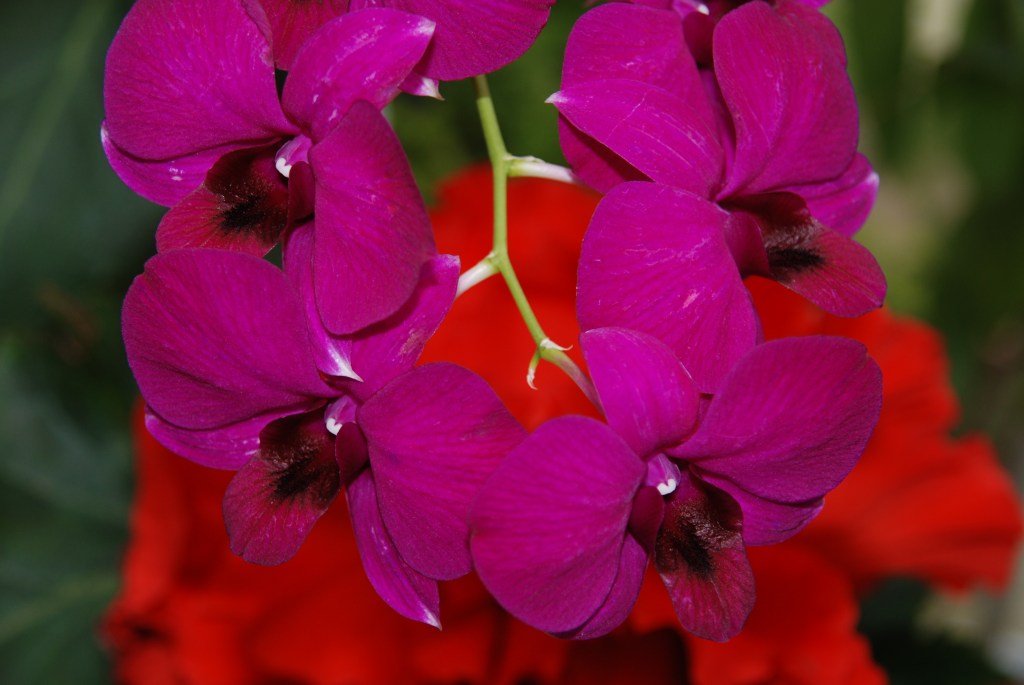
We then went to the flower halls to see the Kimilsungia (a type of Dendrobium orchid) and Kimjongilia (a large red begonia). These flowers are named after the former North Korean leaders and annual flower festivals are held in the flower halls. The Kimjongilia festival held in February and Kimilsungia in April. Among various awards from international floral competitions on display was a certificate from the Royal Horticultural Society. I mentioned that I was a member, and was pressed to take a root of Kimjongilia home. Tempting, but being unsure of the biosecurity and customs implications of importing North Korean begonias to the UK, I tactfully declined.
After that we visited an icy Kim Il Sung Square, which was alive with children maypole dancing, flying kites and playing with whipping tops. It was all very colourful. There was also some singing, and an impromptu game of volleyball. We went off to collect tickets for the afternoon’s concert and when we drove back past Kim Il Sung Square, about an hour after our previous visit, it was deserted.

Lunch was back in the Korean restaurant of our hotel, which had been decorated with balloons and also a display of soft toys for a children’s party. I noticed a Mickey Mouse at the back and had seen a few children with Mickey Mouse backpacks. Not everything American was entirely evil, it seemed. The lunch comprised beansprouts, coconut cake, pork, squid, soup and rice.
After lunch we went to the Moranbong Theatre for a concert. The orchestra was very loud and enthusiastic and played a repertoire of the usual patriotic songs. We were puzzled that a new conductor came on after the first piece. After the concert, we went for a (slightly icy) walk in Moranbong Park, where we, came across a pavilion with Koreans dancing, with more enthusiasm than talent.
That evening we went to the Golden Lanes Bowling Alley. Despite Neil getting a strike with his first attempt, we were soundly beaten into third and fourth place by our guides, though the scoring system was at best eccentric, and more likely broken. It was good fun though.
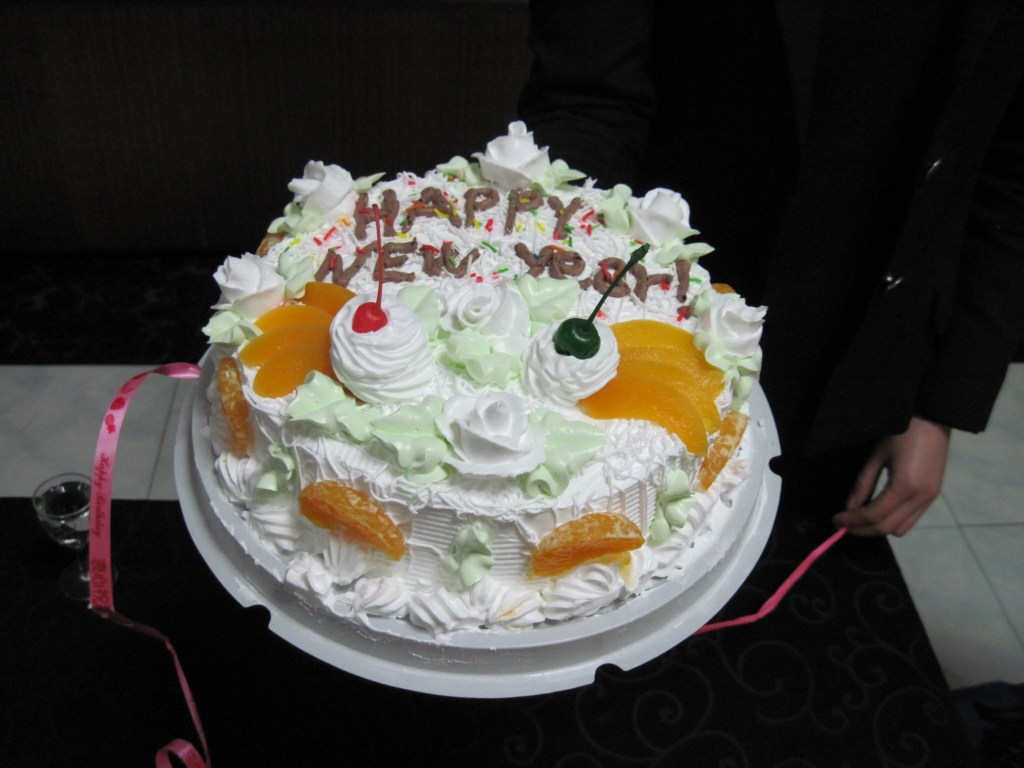
Then it was time for our final dinner, at a Duck Barbecue restaurant. Unlike some of our other dinners, this restaurant was quite busy, perhaps because of Koreans celebrating New Year, but also because other tour groups were there. Our guides had brought a cake as a special treat because it was Neil’s birthday. I was somewhat puzzled as to how to deal with this, but the restaurant brought a knife, and by the power of mime I managed to obtain 5 clean plates so that I could cut pieces for us, our guides and the driver. It was a very good cake (Victoria sponge with apricot jam filling, covered with cream and mandarin oranges), but we only needed one slice each, leaving us with the puzzle of what to do with the other half of the cake. We suggested that other diners might like to share it, so Soong took it around the restaurant, leading to a chorus of Happy Birthday, to Neil’s embarrassment.
This was probably the strangest trip we have been on. North Korea is a country like no other. We saw only what we were supposed to see and were fully escorted (except in those shops.) But we obeyed the rules, avoided political discussions and were made very welcome.
I visited North Korea in December 2015
 Travels with me aren't
Impressive story!
LikeLike
Fascinating to read about a visit at a very different time of year to our own, and travelling on your own as a couple rather than a small group, as we did. Despite those differences, your experiences tally pretty closely with my own. While we were never told we couldn’t photograph the exterior of the war museum (I took lots there), we did have a similar experience in Chongjin regarding photos outside our hotel, and other places too.
I was surprised to read that your guides left you on your own several times, even for a short time!
By the way, it’s my understanding that Kim Il Sung definitely was born at Mangyondae, even if a number of other details of the Kim dynasty’s lives are perhaps interpreted differently in N Korea (e.g. the birthplace of Kim Jong Il and his date of birth). But you’re so right about the lack of balance in their historical accounts!
LikeLiked by 1 person
I don’t suppose we were ‘really’ unsupervised, but it did seem a bit odd.
LikeLike
Yes, I bet someone had their eyes on you, just in case!
LikeLike