There are no wombats on Kangaroo Island, South Australia. Or dingoes either, for that matter. What they do have, aside from the eponymous marsupials, are pure-bred Ligurian bees, as we discovered when our island tour took us to Clifford’s Honey Farm. I am not a beekeeper myself, so please excuse any howlers in what follows.
On arrival, we were given a sparkling honey-based soft drink to try, whilst Sharon, one of the Clifford family, gave us an introductory talk about the history of the farm.
Clifford’s was originally a family sheep farm. Sharon’s father-in-law started keeping bees as a sideline 40 years ago, but the business has grown and now they can produce as much as 20 tonnes of honey in a good year. Last year was a very bad year, and they only got 9 tonnes. They move the beehives every 6 to 8 weeks to follow the flowers. Local farmers let them put hives on their land in exchange for a bucket of honey.
Kangaroo Island had no honey bees until the 1880s. Between 1881 and 1885 a strain of bees was imported from Liguria in Italy. The intention was to breed them and supply the beekeeping industry with a supply of purebred queen bees. In 1885 the Australian Government proclaimed Kangaroo Island to be a sanctuary for these bees, and no more have been imported since then. As Kangaroo Island is beyond the range of bee flight from the mainland, the bees are believed to be the last remaining purebred strain of Ligurian bees.
There are 6 commercial honey farms on the island, as well as some hobby bee-keepers and some who breed queen bees for export elsewhere in Australia and around the world. We were shown the container in which queen bees are packed for travel: about 3 inches long and with three circular cells for the queen and about 8 other bees. Apparently it is very straightforward to send queen bees by post within Australia. You just pop them into a travel container take them to the post office, seal them in a special envelope and send them off. Overseas deliveries can be more difficult!
After the talk we were taken into the honey shed where we were shown the machine where they extract the honey from the combs. At one end, hot water is used to heat the blade that slices off the wax covering. At the other, the combs are spun to extract the honey. The wax is used for candles and other products such as lip salve, so is not wasted. The combs then go back into the hives. Sharon explained that by recycling the combs in this way the bees are able to produce honey more quickly.
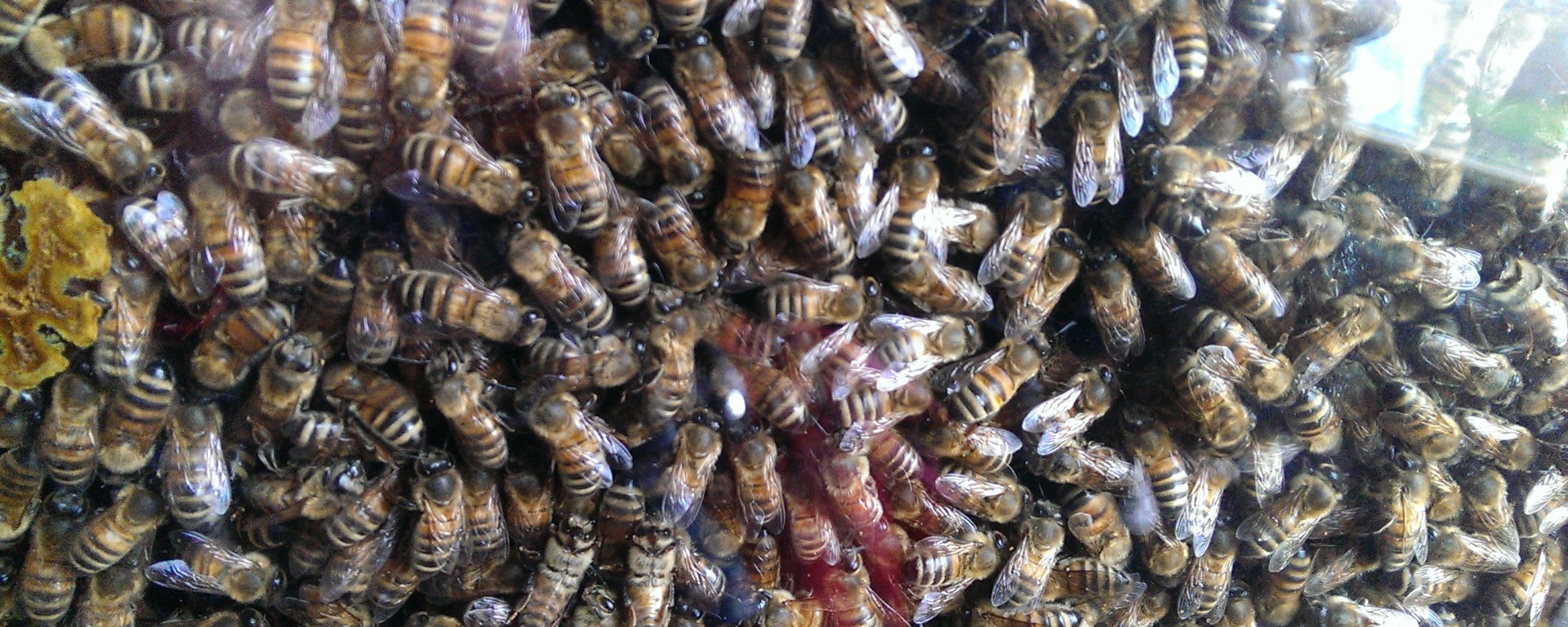
Finally, we were shown some actual bees in a glass fronted display hive. They had put a spot of white paint on the queen so that she can easily be identified. Is this a common beekeeping practice?
The tour ended in the farm shop where we were able to sample the honey. (I felt a bit like Winnie the Pooh, having honey at mid-morning!) We tried three types of honey: spring honey, mainly made from rape (canola), mallee gum and sugar gum, made from the native eucalyptus trees. I preferred the lighter spring honey, perhaps because it was more like the honey I get at home. The eucalyptus honeys were quite strong. The shop also sells other products, including mead, honey ice cream and handmade beeswax candles.
I visited Kangaroo Island in July 2014.

