The Wood and Walters fan in me could not resist. “Two soups, please.” The waiter looked doubtful. “It’s big, maybe one between you with two spoons?” I gave him a look. He relented and brought us two bowls of the spicy lamb soup. It was delicious, and the helpings were generous, but not so as to prevent us from having room for the duck with raspberry sauce. By this time, the waiter had the measure of us. “I’ll bring the dessert menu.”
We had travelled by train from Minsk – the first time I have taken a train across a border. After our passports had been checked, an enthusiastic Jack Russell sniffer dog was brought on to check the luggage. He seemed to me to be more like an enthusiastic puppy than a highly trained operative, but he showed no interest in my luggage, which contained nothing more offensive than Belarussian chocolate. Despite the on-board checks, we had a long wait at passport control on arrival in Vilnius, so we skipped lunch to make the most of our short stay.
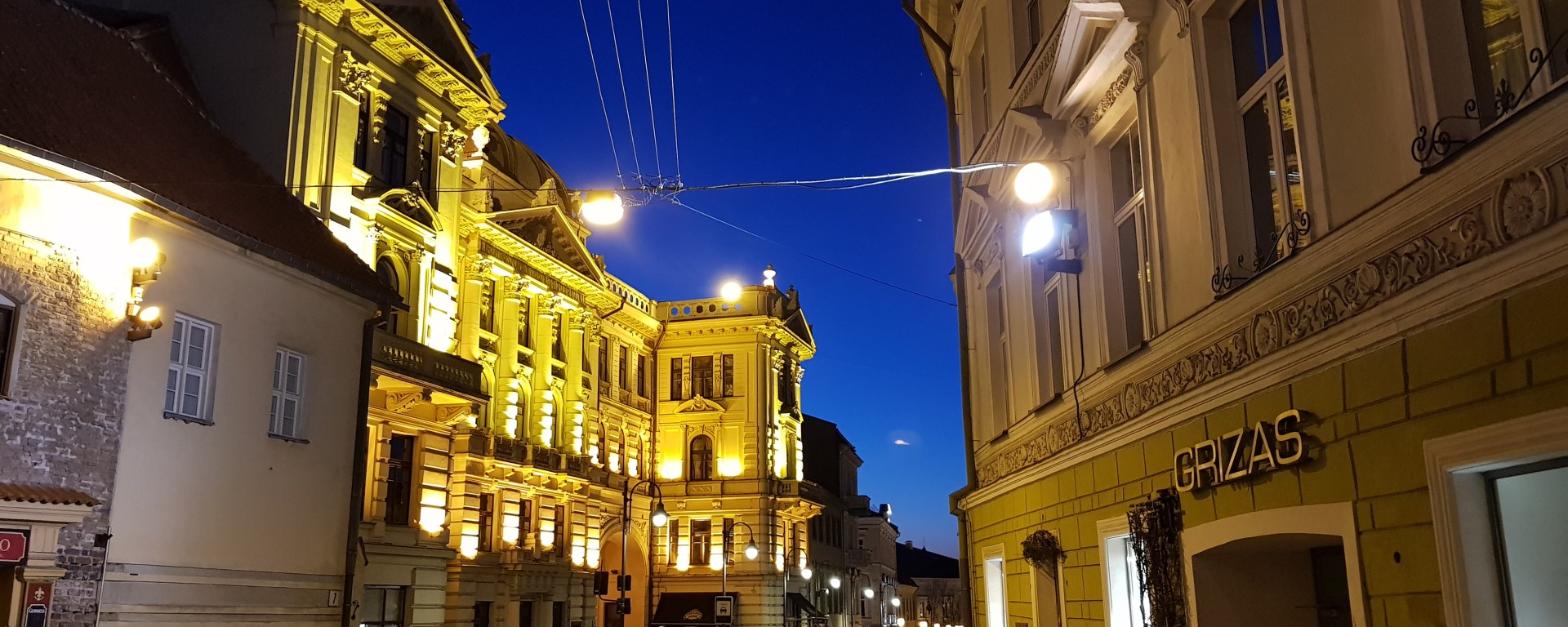
We spent the rest of the afternoon getting our bearings. Our hotel was situated right by the Gates of Dawn and the Old Town, so we were easily able to find our way to Cathedral Square and Gediminas Tower. Leaving the Palace of the Grand Dukes for another day, we turned aside and came to the intricate brickwork of the Church of St Anne. Built at the turn of the sixteenth century, it is constructed from 33 different styles of brick. As a service was in progress we didn’t linger but crossed a bridge to a self-consciously quirky district described in a tourist leaflet as ‘the Montmartre of Vilnius’. The so-called ‘Republic of Uzupis’ declared independence on 1 April 1997 and has its own constitution in 35 languages displayed on a wall. Another wall had a monument to someone who died of pneumonia after lending his overcoat.
Our second day started with another random monument: a Frank Zappa statue. Things then took a more sombre turn as we visited the Holocaust Museum, which told the disturbing history of the Vilnius ghetto and how many Jews were killed. One of the most unsettling exhibits was a memo to a senior Nazi official explaining that if any more Jews were killed there simply wouldn’t be any plumbers and glaziers left in the city. The final part of the exhibition is a recreation in the attic of a typical hideout: sitting in the dark, listening to the soundtrack of the building being searched and a baby crying was truly disturbing.
It was probably not the best idea to go straight from there to the former KGB HQ, now the Museum of Oppression, to see what the Soviets did in their turn. This was even more grim. I had been to a former KGB HQ before in Tomsk, but it was nothing to this. The old KGB cells in the extensive basement included including a padded, soundproofed cell and two cells adapted for water treatment where the prisoner had to remain standing on a small concrete plinth or fall off into icy water.
After that we took the funicular up to Gediminas Tower for some much-needed perspective. It proved a wise move. The film about the Lithuanian resistance movement in 1989-90 that was showing inside went some way to restore my faith in humanity. I also managed to conquer my fear of narrow spiral staircases to make it to the viewing platform on the top of the tower.
Returning to Cathedral Square, we visited the Palace of the Grand Dukes, now the National Museum. The original palace was demolished more than 200 years ago during the tsarist occupation, but it was reconstructed as part of Lithuania’s Millennium Programme. Our tour took us through the ruins of the original palace in the basement to the reconstructed staterooms above. As a symbol of Lithuania’s longstanding and resurgent statehood, that made a fitting finale to our visit.
I visited Vilnius in April 2019.
 Travels with me aren't
You’ve certainly sold Vilnius to me, despite the challenging nature of some of the sights
LikeLike