
We almost didn’t make it to Apollonia.
The road was closed and we had to find another route, slaloming between rocks on a partially surfaced road. But when we finally arrived, we had the entire site to ourselves, apart from a couple of cyclists we saw in the distance, and it was well worth the effort.
The bouleuterion, or council meeting place dates from the Hellenistic period. We were told that an inscription states that it was erected by Quintus Villius Furius Proculus in memory of his brother. Opposite the bouleuterion is the theatre or odeon, a 2nd-centry AD Roman building. We walked along the remains of a street, with views of the acropolis, before stopping for much-needed refreshment in the former house of Leon Rey, the French archaeologist who excavated the site in the 1920s and 30s, which had been turned into a pleasant (but empty) bar/restaurant.
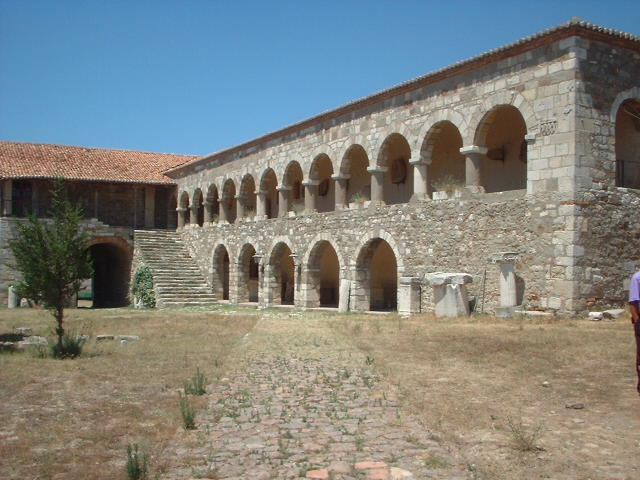
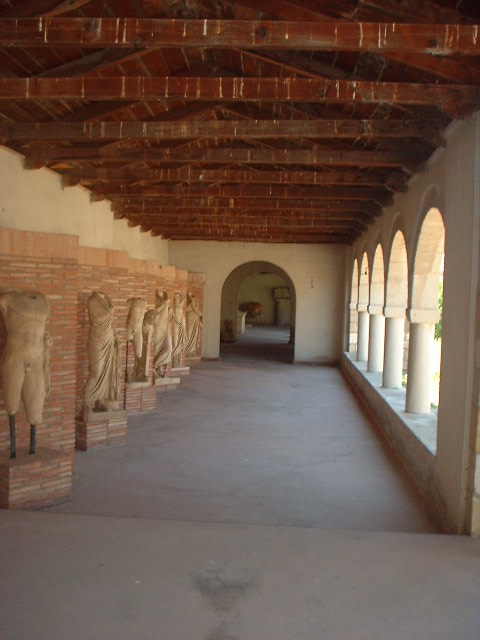
We then visited the Monastery and Church of Shën Mëri, containing the Apollonia Museum. An archaeological dig was in progress within the confines of the monastery. The caretaker who showed us around the museum was however not too well-informed. There was a whole row of headless statues, and my husband, wondering perhaps whether they had been deliberately decapitated by later invaders, asked why they were headless. “Because they have no heads” came the reply.
We visited Albania in 2003
 Travels with me aren't