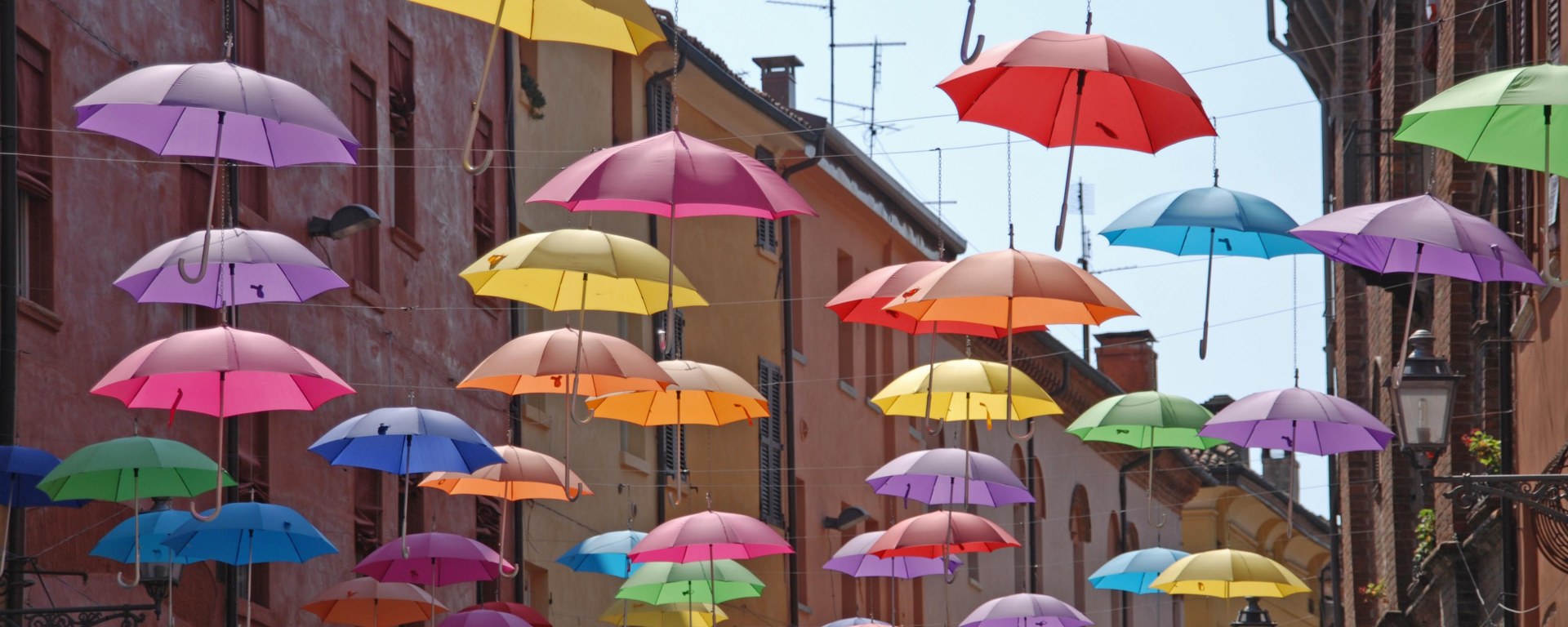
Our exploration of Ferrara started slightly later than planned, as we took the wrong turn on leaving the station and ended up walking the long way round and entering via Porta Paula, just in time for much-needed elevenses at a café in Piazza Trento e Trieste. A nearby street was decorated with hanging umbrellas.
From our vantage point we could see the cathedral or Duomo, with lots of little shops along the wall. The cathedral, dedicated to St George, dates back to the 12th century and was consecrated in 1135. It is particularly known for its three-tiered marble facade, which combines Gothic and Romanesque styles. Unfortunately this was under restoration when we visited so we were unable to admire it. We were however able to visit the interior, which is mainly Baroque in style, having been rebuilt after a fire in the 18th century.
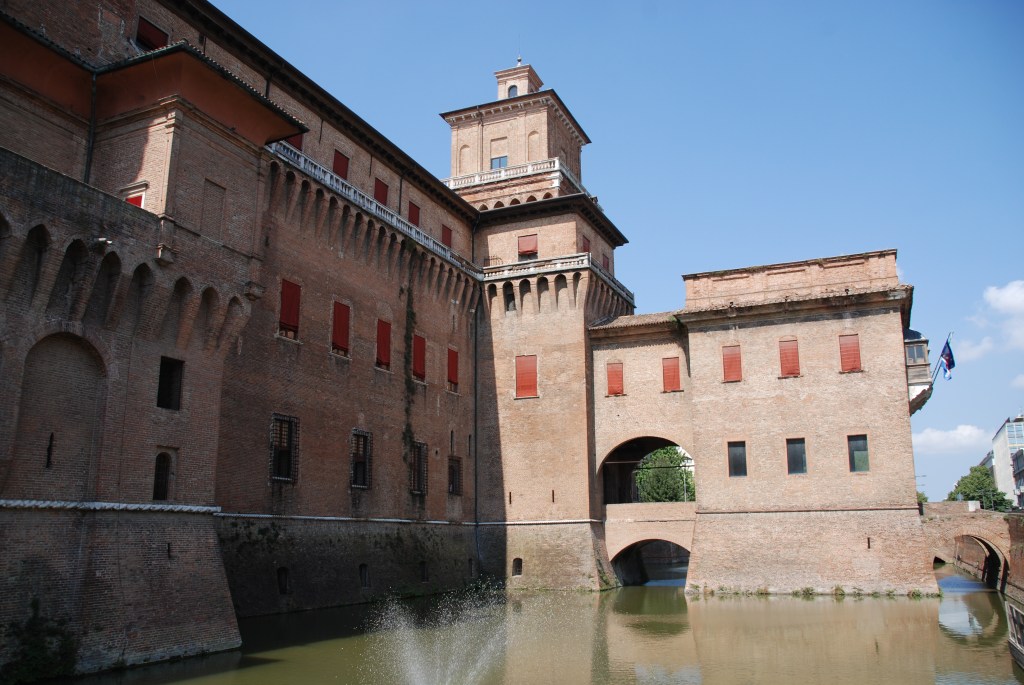
The Castello Estense made up for our disappointment over the Duomo façade. It is a moated castle right in the middle of town. The building was commissioned by Nicolò II on 29 September 1385, and designed by Bartolino da Novara. It was originally intended as an impregnable fortress to protect the Duke and his family from the local population who were protesting about tax increases. In the late fifteenth century it became a permanent residence.
Our tour started in the dungeons, which were reserved for high-ranking prisoners. It was here that Duke Nicolò III had his young second wife Parisina and his son Ugo beheaded in 1425 after discovering that they were having an affair. Rather more fortunate were Guilio and Ferrante d’Este, brothers of Alfonso I, who were imprisoned in 1506. They were sentenced to death for plotting against the duke, but their sentences were commuted to life imprisonment. Both were incarcerated for a long time: Ferrante for 43 years and Guilio for more than fifty. He was finally released in 1559 at the age of 81. Historical sources relate the astonishment of the crowd at seeing an elderly man dressed in the fashions of fifty years earlier walking down the street.
Among the state rooms upstairs are the apartments occupied by the duchesses of Ferrara. One of them was Lucrezia Borgia, daughter of Pope Alexander VI, who married Alfonso I. This was her third marriage. Her first, contracted when she was 13, to Giovanni Sforza of Pesaro had been annulled, and her second, to Alfonso d’Aragona duke of Bisceglie, ended when he was killed by assassins sent by her brother Cesare. By these standards her marriage to Alfonso I d’Este was more successful. From this union came the future duke Ercole, cardinal Ippolito, Francesco, Marquis of Masslombarda, a daughter Eleanora who became a nun, and two other children who did not survive to adulthood. Lucrezia died in childbirth in Ferrara in 1519. According to the information boards in the apartments of the duchess, Lucrezia was actually a caring mother and deeply religious woman who had rather a bad press. The apartments of the duchess lead out to a pleasant orange garden.
The state rooms have attractive painted ceilings – even the room where the visitors’ toilet has been installed. One of the rooms is decorated with coats of arms which have nothing to do with the Estense Dukes. The decoration dates from the period when the papacy had taken over the castle and shows the family arms of the papal legates.
After all that sightseeing we stopped for lunch in a café near the castle. Our food came with the traditional Ferrara bread, ‘coppia ferrarese’ white bread twisted into a horn shape.
In the afternoon we took a stroll in the Parco Massari and enjoyed a gelato before visiting the Museo de Risorgimento – small municipal museum about the Risorgimento and the Resistance in WWII. Although we don’t have fluent Italian, we nevertheless managed to understand quite a lot. The collections cover the period from the French occupation of Ferrara in 1796, including the activities of the so-called Carbonari (charcoal-burners) in 1820-21 and 1823; the role of the Company of Ferrara Bersaglieri del Po (founded in Ferrara in 1848); the Ferrara martyrs Succi, Malgutti and Parmegianni and events after the Unification up to 1945.
From there we found a much quicker route back to the station.
I visited Ferrara on a day trip from Bologna in 2016.
 Travels with me aren't