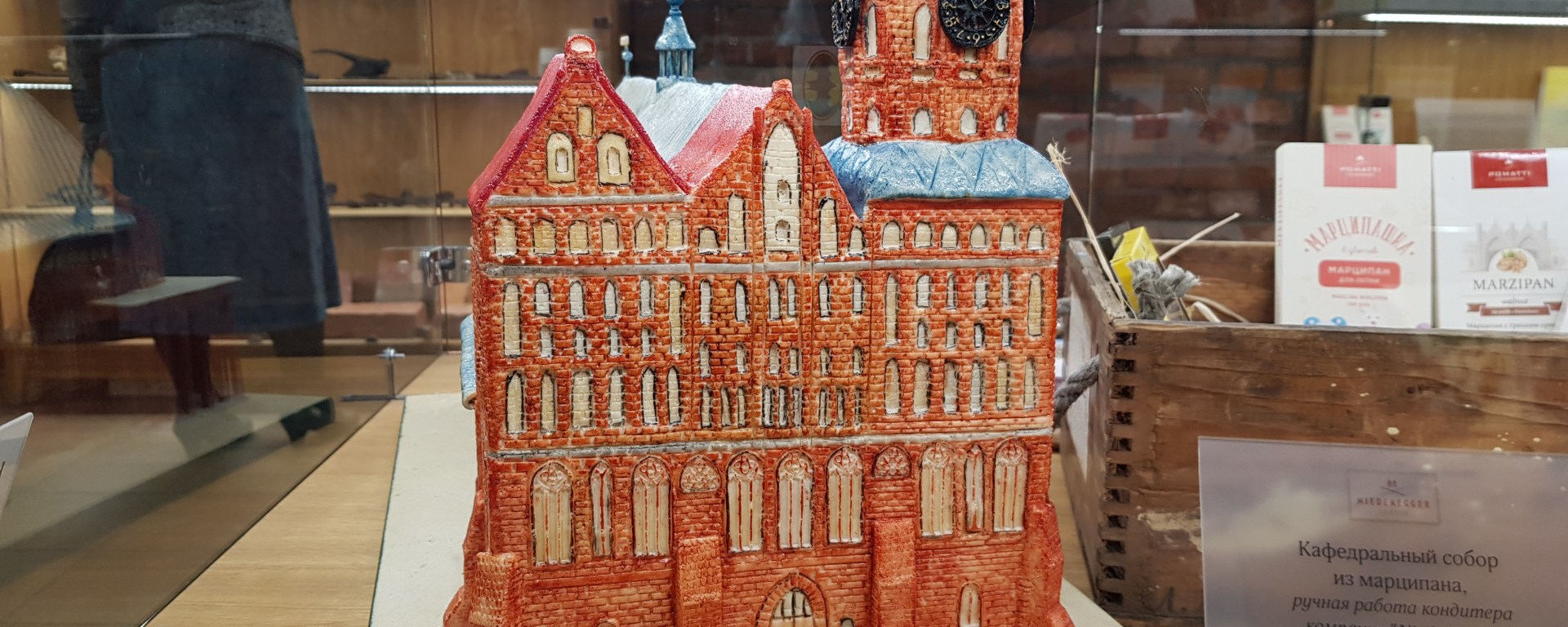
If there is one place that captures the essence of Kaliningrad, it is the Museum of Marzipan. Formerly the German city of Königsberg, home of philosopher Immanuel Kant, later a Soviet port closed to visitors, Kaliningrad is now a Russian exclave opening up to tourism. Two iconic buildings: the cathedral, and ‘the monster’, an ugly and unfinished Soviet era office block, erected on the site of the former Königsberg castle, can be seen accurately sculpted in the almond paste for which the city was once famous.
The castle may be no more, but many of the old city fortifications remain. In the past Königsberg was once of the most highly fortified cities in Europe. The Marzipan Museum itself occupies the Brandenburg Gate. The Friedland Gate houses a Museum about old Königsberg. Another fortification contains the obligatory Museum of Amber, which no self-respecting Baltic city would be without.
Model buildings are something of a feature of Kaliningrad. Near the Friedland Gate, Yuzhny Park has a delightful outdoor exhibition of architecture from around ‘Great Russia’ – miniature models of Russian buildings, of which a model of Königsberg Castle is by far the largest. There are also model dioramas of Königsberg in the Bunker Museum (the former underground WW2 German HQ under a square near the university.)
Other model buildings can be found in and around the cathedral on Kant Island. Named after the famous philosopher Immanuel Kant, the island was once filled with city streets and housing, but after the bombardment in World War II only the cathedral remains, surrounded by a sculpture park. When we visited, half of the sculpture park was cordoned off for preparations for a Chinese lantern festival.
Inside the cathedral is a museum, containing exhibits about Kant, who was one of the few figures from the city’s history who was acceptable to the Soviets. There is also a large model of old Königsberg, and a room with exhibits about the Teutonic Order, who ruled the medieval city. In the fourteenth century, when the cathedral was built, there was a fear of attacks by Prussians and Lithuanians, so it was designed with very thick walls for protection. The story goes that in as the cathedral began to take shape, the Master of the Teutonic Order suddenly banned the construction and demanded that the bishop explain whether he was building a cathedral or a fortress.
Across the river from Kant Island is the Museum of the World Ocean: a large riverside complex comprising an oceanography museum and small aquarium together with a number of vessels moored on the quayside. We only visited the museum itself, and did not go on the submarine or any of the other ships, but viewed them from the promenade. The Cosmonaut scientific vessel still has an active telemetry link with the International Space Station.
Kant Island and the nearby ‘Fishing village’ are the tourist hub of modern Kaliningrad, with guided tours, souvenir stalls, boat trips and cafés. The riverside promenade may be recent reconstructions, but it is a pleasant place to wander and find some lunch. On the subject of food, Kaliningrad has extremely child-friendly restaurants. At Parmesan, an Italian restaurant near our hotel, we enjoyed an excellent meal, somewhat distracted by the hordes of children playing tag around the tables. They don’t just offer a child-friendly menu: they even run weekend cookery classes for children. One of the restaurants on the waterfront has a sand pit in the middle, a bouncy castle and toy cars. The child-friendly atmosphere isn’t just limited to restaurants. Small children treat the plinth of a Mother Russia statue as a slide, encouraged by their parents.
I was not sure what to expect from Kaliningrad, but what I found was a city with a fascinating history, excellent cafés and restaurants and a sense of fun.
I visited Kaliningrad in April 2019
 Travels with me aren't