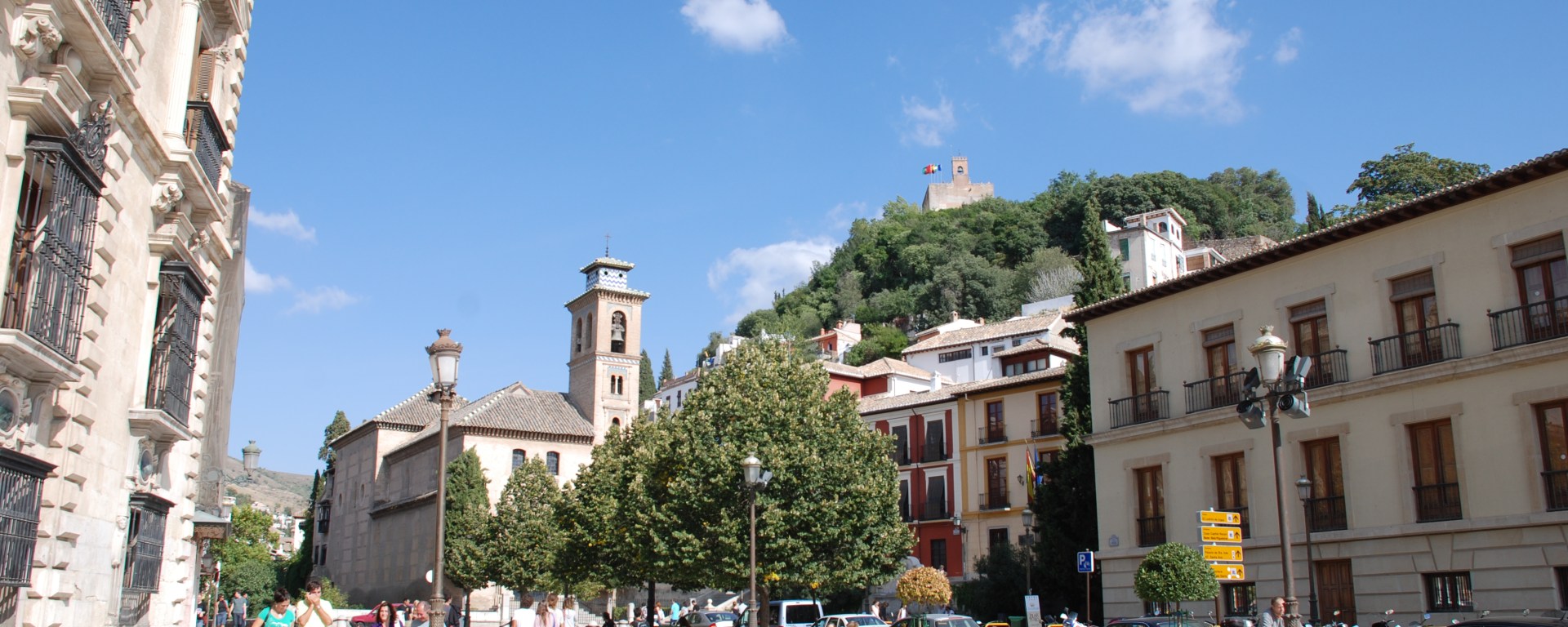
He pedalled on serenely, little caring that he was going nowhere. At first I barely noticed him. Pausing in my exploration of the city, I had perched on the edge of a fountain to enjoy the October sunshine. At a nearby cafe table a family dunked gigantic churros into cups of hot chocolate, whilst Winnie the Pooh wandered around the square selling helium-filled balloons. I gradually became aware that there was something odd about the children’s roundabout in the corner of the Plaza. The horses and dragons the children were riding were black, rather than brightly-painted, and seemed less rigid than usual. They hung from the canopy like harnesses into which parents carefully lifted their children. In fact, they appeared almost as if they were made of leather. I took a closer look. No, not leather, but rubber. I finally realised that I was looking at a menagerie fashioned from old tyres. It was then that I noticed that the roundabout was not propelled by the usual wheezing, smelly, generator, but by a small bespectacled man on a converted bicycle. This was no ordinary children’s ride; it was an ‘ecological carousel’. A green fairground attraction was not something I had expected to find in this city, but nothing I had seen so far this morning was expected.
I had decided to avoid the obvious tourist attractions and roam the city at random to see what else it had to offer. My first discovery had been a monastery whose forbidding stone exterior gave way to a tranquil inner cloister. The cloying scent of citrus from the trees filling the central courtyard was almost overpowering. Visitors flock to this city in search of peaceful courtyards, but I had this one to myself. Walking around the cloister, I encountered doors leading to the refectory, the sacristy and chapter house, simply decorated rooms with whitewashed walls and furnished with dark wood. Outside the chapter house, memorial slabs for departed monks were let into the paving, some of them partly obscured by potted aspidistras. I completed my circuit of the cloister thinking I knew what to expect from the final door. But this portal led me to a completely different world: the chapel was highly ornate with deep ceiling reliefs, exuberantly painted walls and a gilded altarpiece. Here the silence of the cloister was replaced by taped baroque music. A duchess had acquired the right to use the chapel as a family burial place and had allowed her architects free rein to redecorate. I wondered what the monks had thought of this architectural cuckoo in their monastic nest.
Not far from the monastery, I had encountered another Renaissance courtyard, this time highly decorated with wall paintings and bright majolica tiles. It, too, contained a surprise: the art on the walls was disfigured by ugly modern notices and signs leading to gynaecology and oncology clinics. The building was still in use as a busy working hospital.
I strolled on past the central Post Office, where members of a youth band, dressed in smart purple uniforms, lounged aimlessly, their performance apparently over. A somnolent bulldog, legs splayed, lay near their feet. Further along the street was a fleamarket with coins, stamps and postcards for sale. Beyond this, there appeared to be a bustling textile and haberdashery market. On reaching it, I realised my mistake. The ‘market stalls’ were trestle tables at which women were seated, working at lace pillows with numerous bobbins, whilst a crowd surged around. Although there were a few stalls selling bobbins, patterns and other lace-making paraphernalia, the point of the event was a mass lace-making rally.
As I retraced my steps through the narrow streets towards my hotel, I passed a number of tea shops, or at least, establishments selling tea. Anyone in search of scones with jam and cream here would be disappointed. I paused by a parapet. In the gorge below, a grey and white cat and her two kittens picked their way delicately through the undergrowth that flanked the river, finally selecting a large leaf beneath which to settle down for a siesta, shaded from the fierce noon heat. The gorge, like the whole city, was overshadowed by the iconic building looming above the houses on the other side of the river. So far, I had resolutely ignored its dominant presence. This morning I had been in search of the unknown side of the city, the part never seen by the crowds who come only for the palaces and gardens concealed by those forbidding walls. At last I relented and gazed up at the Alhambra of Granada.
I visited Granada in October 2008
 Travels with me aren't